
Costs
How Much Does Water Damage Restoration Cost in Katy, TX?
By Hydrosphere Restoration ProsUpdated 7 min read
The short answer
There’s no honest flat price for water damage restoration in Katy, TX. Cost is set by the water category, how many square feet and rooms got wet, which materials soaked up water, and how many days of drying the job needs. Clean-water leaks caught early cost least; sewage, floodwater and late discoveries cost most.
Why You Won’t Find a Price List Here
Two leaks that look the same from the doorway can be very different jobs. A supply line that burst an hour ago under a kitchen sink might wet one room of tile. The same line leaking slowly behind a wall for a week can soak the cabinets, the drywall and the carpet pad in two rooms and leave early mold behind the baseboards.
Any price quoted over the phone before someone takes moisture readings is a guess. What you can get before work starts is an explanation of what will be done, how it’s measured and how it’s billed, in a written, itemized scope. The sections below show what moves the number, so you can read that scope with confidence.
The Main Cost Drivers
| Factor | Pushes the cost up | Keeps the cost down |
|---|---|---|
| Water category | Category 3 sewage or floodwater: protective gear, more material removed, disinfection | Category 1 clean water from a supply line, caught early |
| Affected area | Several rooms, two floors, water inside walls and ceilings | One room on one floor, water mostly on the surface |
| Materials | Carpet pad, hardwood, floating floors, tall wet drywall, particleboard cabinets | Tile on slab, drywall wet only a few inches up |
| Drying time | More days on site with more air movers and dehumidifiers | Fast extraction and a short drying cycle |
| Contents | Pack-out, cleaning and storage of furniture and belongings | Belongings moved by the homeowner before the crew arrives |
| Timing and findings | After-hours start, mold found once walls are opened | Daytime start, no hidden growth |
Water category
Category 1 water comes from a clean source like a supply line or ice maker. Category 2 carries contaminants, such as washer discharge or a dishwasher overflow. Category 3 is sewage or floodwater. As the category rises, more material has to be removed instead of dried in place, and the protective gear and cleaning steps add up. Clean water left sitting for days can also degrade into a higher category.
Square footage, rooms and floors
Most mitigation line items are billed by the square foot or by the unit per day, so the size of the wet area drives most of the total. A two-story leak costs more than a one-story leak of the same volume, because the water wets the ceiling, insulation and wall cavities on the way down, and each floor needs its own equipment.
Materials that got wet
Carpet can often be dried, but the pad under it usually can’t and gets replaced. Hardwood and engineered floors need specialized drying and more time. Laminate or vinyl plank floated over foam underlayment often traps water against the slab. Drywall wet higher up the wall needs a taller flood cut, and particleboard cabinet bases swell and rarely recover.
Drying days and equipment count
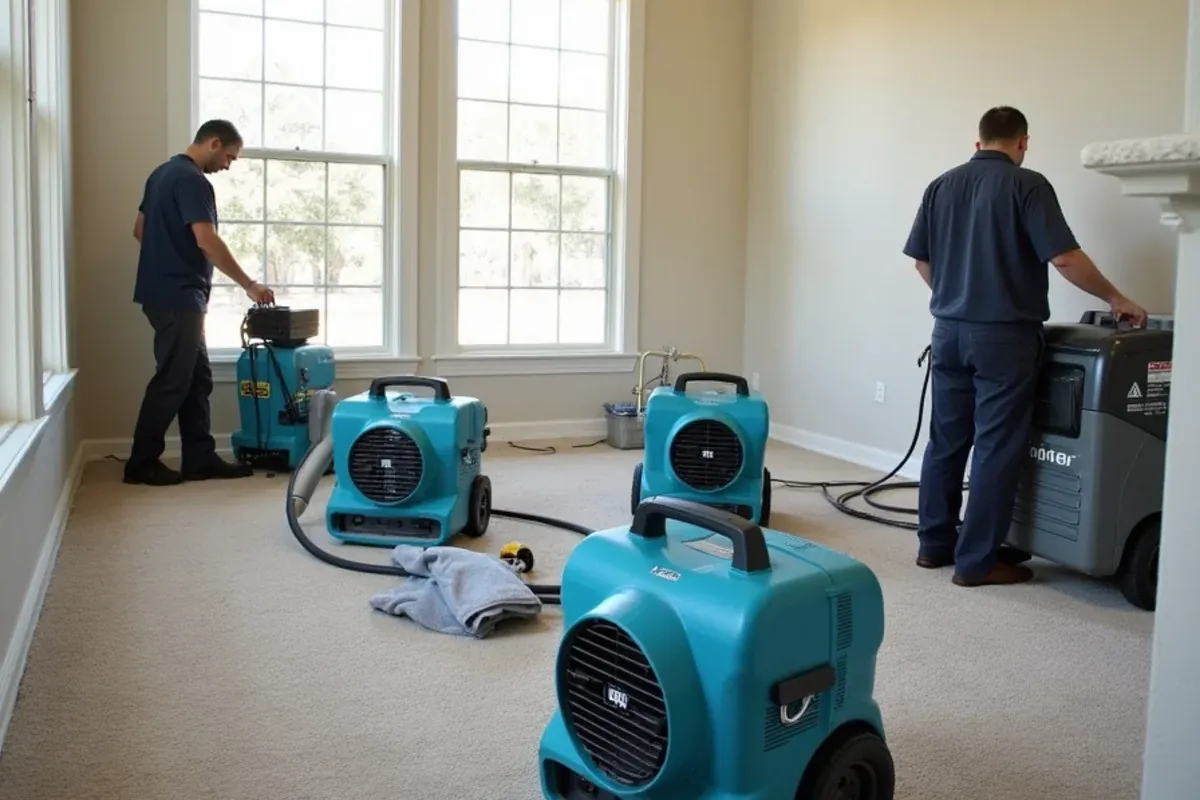
Air movers and dehumidifiers are billed per unit, per day. The number of units follows industry guidelines based on room size and wet surfaces, and the number of days depends on how fast readings come down. Gulf Coast humidity and dense materials like hardwood both stretch drying out.
Contents, after-hours work and mold
Moving, cleaning and storing belongings is its own set of charges. Some contractors bill more for night or weekend starts, so ask about that when you call. And if the crew opens a wall and finds mold, the job changes: containment and removal add cost, and in Texas 25 contiguous square feet or more goes to a TDLR-licensed mold remediation contractor.
Mitigation and Rebuild Are Two Different Bills
Mitigation is the emergency part: extraction, removing wet materials, drying and cleaning. Rebuild, sometimes called reconstruction, puts the house back together with new drywall, paint, baseboards, flooring and cabinets. The two are often estimated separately, sometimes by different companies, and insurers often review them separately too.
When you compare quotes, make sure you’re comparing the same scope. A low number that covers mitigation only isn’t cheaper than a higher number that includes the rebuild.
How to Read an Itemized Estimate
Many insurers price mitigation with estimating software such as Xactimate, which breaks a job into line items with units. A good restoration scope is built the same way, so it can be checked against the adjuster’s estimate line by line. These are common items and how they’re usually measured.
| Line item | Usually measured by | What it covers |
|---|---|---|
| Water extraction | Square foot | Removing standing and absorbed water from carpet, pad or hard floors |
| Air mover | Unit per day | Fans that push air across wet surfaces to speed evaporation |
| Dehumidifier (LGR) | Unit per day | Pulling moisture out of the air so materials keep drying |
| Moisture monitoring | Visit or day | Daily readings and a drying log that shows progress |
| Flood cut | Linear foot | Cutting drywall a set height above the water line, commonly 2 or 4 feet |
| Pad and carpet removal | Square foot | Tearing out wet pad or carpet that can’t be saved |
| Antimicrobial application | Square foot | Treating surfaces after cleaning and removal |
| Debris removal and disposal | Load or hour | Hauling away wet drywall, pad and other removed material |
If a line doesn’t make sense, ask what it is and why it’s needed. The moisture readings should back up every removal decision, and the drying log should explain the number of equipment days.
Your Deductible and Texas Law
If the loss is covered, your deductible is your share. Texas law (Business and Commerce Code section 27.02) prohibits contractors from offering to waive, pay or rebate an insured homeowner’s deductible, so an offer to “take care of your deductible” is a warning sign, not a discount. Our post on whether homeowners insurance covers water damage in Texas explains what typically is and isn’t covered.
Newer Homes Aren’t Automatically Cheaper to Dry
It’s easy to assume a newer house means a smaller bill. In Fulshear and other fast-growing communities, many calls come from supply line fittings, upstairs laundry rooms and attic air handler drain lines. An upstairs washer leak can wet the laundry floor, the ceiling below and a stretch of first-floor wall, which makes it a two-floor job in a house only a few years old.
Floating vinyl plank floors, common in newer builds, can hide water underneath until a meter finds it. Our page on burst pipe and leak water damage covers these leak types in more detail.
Ways to Keep the Cost Down
- Shut off the water fast and call right away. Every hour of spread adds square footage.
- Move belongings out of wet rooms yourself if it’s safe to do so.
- Keep the AC running on clean-water losses unless water reached the system.
- Photograph everything before anything is removed, so the scope is easy to support.
- Ask for the moisture map and daily readings so you can see when drying is actually done.
- Get the source repaired promptly so the same room doesn’t get wet twice.
Get an Itemized Scope for Your Home
The cost of water damage restoration in Katy comes down to what got wet, how badly and for how long. The only way to know what your job involves is to have it measured. Call Hydrosphere Restoration Pros at (831) 303-1192, any hour, and we’ll dispatch an insured crew that starts with moisture readings and a written scope for water extraction and drying before work begins.
From the job site
Where the money actually goes on a Katy water job
Most homeowners see one number, but a water loss is really two jobs with two invoices. Mitigation covers the emergency work: extraction, removal of what cannot dry, equipment days and the daily monitoring visits. Reconstruction is the rebuild that comes after: new drywall, paint, baseboards, flooring and cabinets. Keeping them separate on paper is the easiest way to see what you are paying for and what your adjuster is reviewing.
On the mitigation side, time is the multiplier. Every extra day a room stays wet adds equipment days, and water that sits long enough to change category means more material comes out. The cheapest job we see is almost always the one where someone called the same day.
- Equipment is billed by the day, so ask how many air movers and dehumidifiers are planned and how often readings are taken.
- Removal and disposal show up as their own lines: pad, baseboards, drywall by the square foot, cabinets by the linear foot.
- Mold discovered behind a wall after it is opened can move part of the job into licensed mold remediation, with its own scope.
- A bid that skips daily readings is not really cheaper; it often ends with drywall closed over wet framing and a second bill later.
- Ask whether after-hours or emergency fees apply before work starts, not on the invoice.
Related questions
Why won’t anyone give me a water damage price over the phone?
Does insurance pay the restoration company directly?
How long does water damage restoration take?
Written by the Hydrosphere Restoration Pros team for homeowners in Katy and nearby communities. General information, not legal, insurance or engineering advice: your policy, the Texas Department of Insurance and licensed professionals have the final word on your situation. Last reviewed September 2026.